
The general scenario includes mounds of paperwork, busy healthcare providers working on strict timelines, reporting errors, and inefficiencies. 70% of healthcare professionals spend an average of 10+ hours a week on paperwork and administrative tasks, and 32% invest 20+ hours of their bandwidth. The data is worrisome!
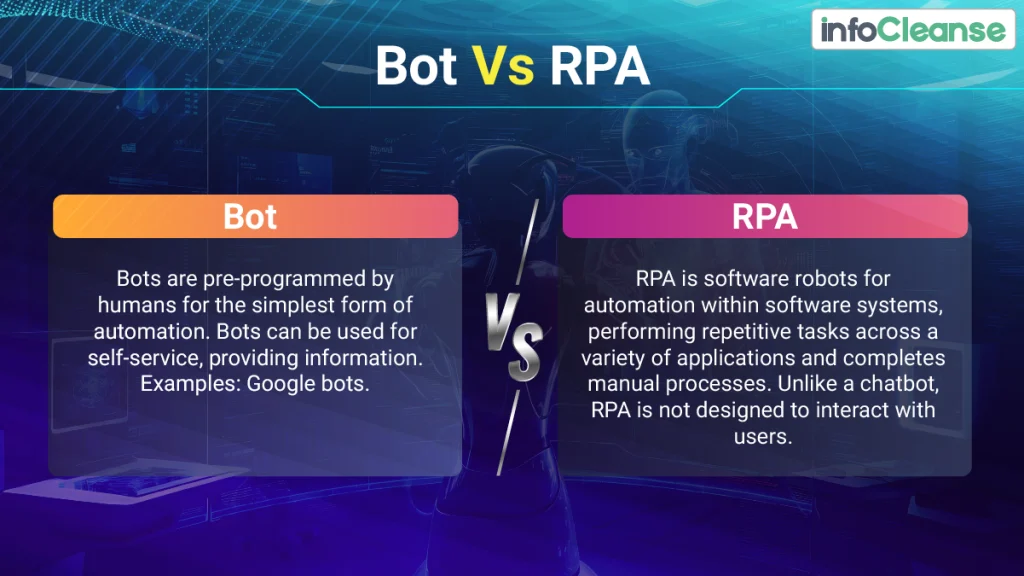
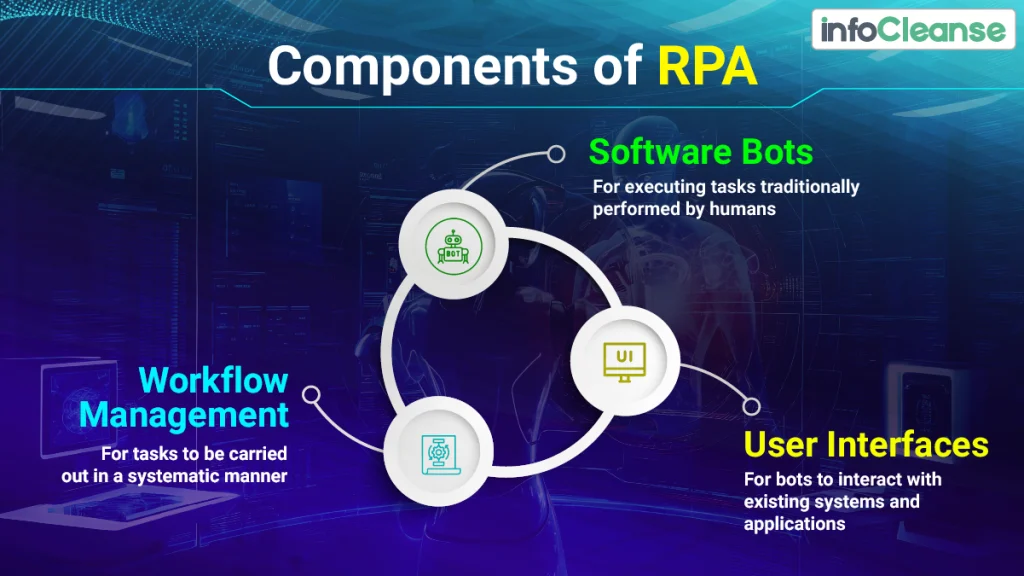
Robotic Process Automation is a bot or software robot that can automate repetitive tasks to streamline operations and enhance efficiency. As an intelligent tool, RPA in healthcare functions as a boot; it can take up the same tasks that humans do and deliver them rapidly and with no errors. RPA allows healthcare entities to automate many parts of work and focus on their core goal of providing excellent care to users.
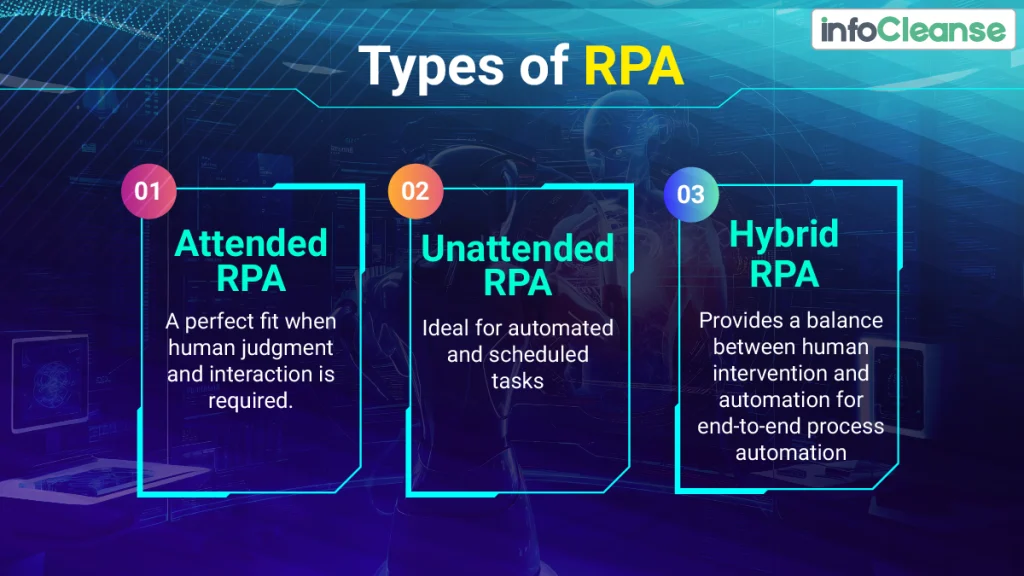
Do you know the difference?
RPA: The Need of the Hour for Healthcare

RPA in Healthcare: Triggering Efficiency and Bringing Value
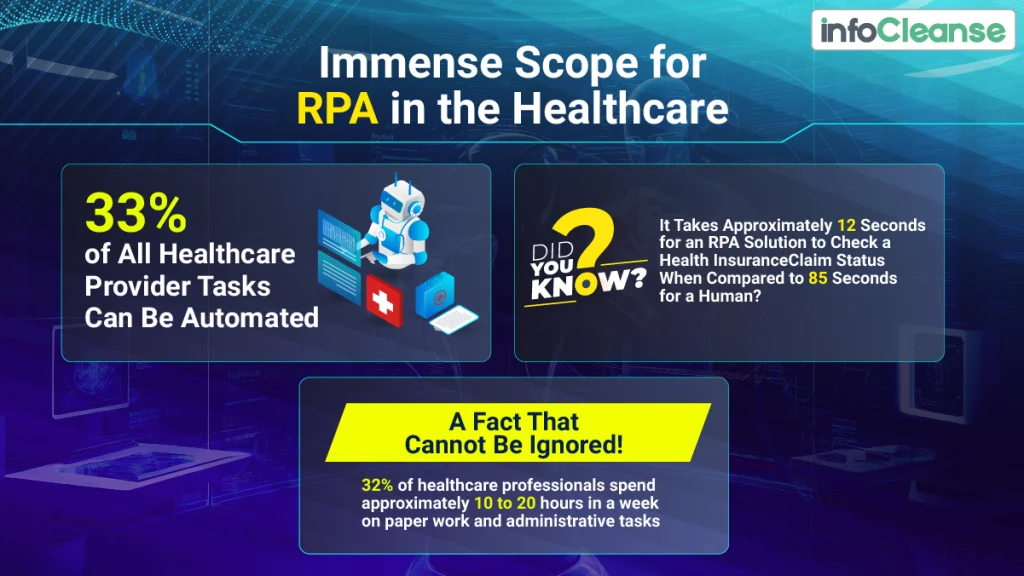
A few of the impactful benefits RPA has bestowed on the healthcare industry are as follows:
1. Explore Personalization and Enhance User Care
2. Skyrocketing Productivity and High ROI

3. Increased Accuracy and Effective Decisions
4. Robust Compliance Posture and Reduced Risks
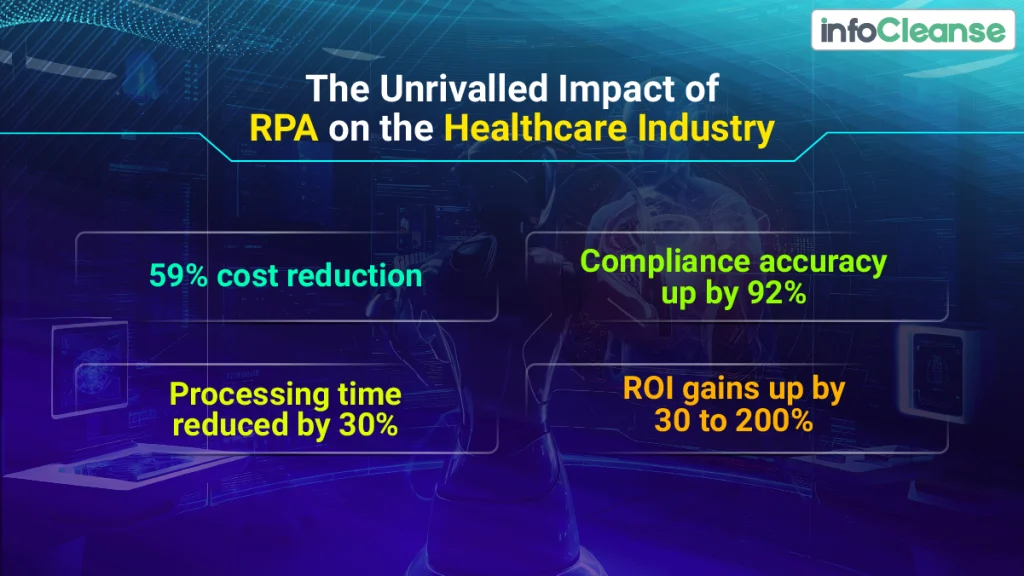
A data privacy breach and hefty fines jeopardizing the reputation of a healthcare enterprise is a scenario no one desires. Healthcare organizations must ardently maintain a robust compliance posture to ensure this becomes a reality. It is where RPA comes in handy! RPA eliminates the risk of human errors in data entry, enhancing user information and billing accuracy. By strictly ensuring consistent application of rules and guidelines, RPA obliterates the risk associated with compliance issues. Besides this, by monitoring data privacy, RPA empowers healthcare businesses to overcome legal hassles related to data privacy breaches and secure a compliance accuracy by 92%.
5. Secured Data and Safeguarded Financial Pursuits
RPA regulates users’ access, ensuring that the electronic data healthcare enterprises possess adheres to privacy norms. With RPA quickly detecting and responding to cyber-attacks, organizations can evade data security breaches and secured their financial interests. Additionally, with RPA as their automation tool, healthcare providers can track and document every step of a process for external audits and slice through a complicated data privacy maze.
6. Proactive Interventions and Improved Clinical Outcomes
With the advent of RPA in healthcare, medical professionals in healthcare facilities and other centers can invest their bandwidth into better use. They can invest more time and effort toward patient care, track their recovery, and more. Additionally, RPA enables remote patient monitoring, case management, and treatment coordination, allowing hassle-free tracking of patient health progress. It can provide personalized treatment regimens to patients, send alerts and notifications, and ease processes for healthcare professionals and users seeking care. By accurately analyzing data from various sources, RPA in healthcare can identify high-risk candidates in dire need of proactive intervention, escalate it to the concerned point of contact, and enable quick problem resolution.
7. A High Volume of Tasks and Scalable Operations
RPA can work wonders for healthcare organizations vying to expand their operations without additional costs. Via RPA, healthcare enterprises can scale up automating rule-based repetitive tasks without splurging on extra resources. Therefore, healthcare facilities can save time, effort, and costs and focus on endeavors that positively impact their revenue growth. By reducing processing time by 30-50%, RPA is making improved operational efficiency a reality for several organizations.
8. Minimizing Costs and Increasing Profits
Once put to use, RPA can drastically reduce the costs associated with specific tasks. 61% of enterprises leverage RPA to reduce their expenses from the benefits RPA bestows through automation. They are witnessing a high ROI, i.e., a return of USD 6.74 for every USD 1 invested in RPA for their day-to-day operations. Operating round-the-clock, RPA drives efficiency and reduces manual labor costs by 59%. The healthcare industry could save around $25 billion annually by merely automating administrative tasks. By leveraging RPA, healthcare business entities can have accurate billing processes and reduce claim denials and mistakes that occur due to human errors, ultimately culminating in lower operational costs.
Usage Scenario of RPA in Healthcare
1. RPA as Digital Assistants for Scheduling Appointments
When tasks are done on a large scale, they are prone to errors, which applies to appointment scheduling in the healthcare industry. RPA bots can act as digital assistants, automate a large chunk of tasks, and facilitate appointment scheduling. For instance, RPA bots can consider a healthcare professional’s availability and a patient’s choice of time and provide a time slot that suits both. It can estimate appointment duration and even notify both the patient and healthcare professional in case of any change, eliminating any scope of ambiguity and inconvenience.
2. RPA for Easing Out Tedious Eligibility Verification
Increased patient volume helps healthcare organizations boost their revenue margins, but with it comes the labor-intensive woe of verifying their eligibility for insurance claims. However, with RPA, this becomes a hassle-free process for healthcare enterprises. RPA streamlines tedious, rule-based tasks by extracting user data from repositories and CRM or EHRs. It enables healthcare executives to arrive at data-backed decisions swiftly. It can also send automated emails to users to verify their coverage and benefits, helping healthcare executives to fast-track the claims process.
3. RPA for Better Care and Improved User Satisfaction
4. RPA for Timely Data Corrections and Compliance Adherence
RPA bots help healthcare enterprises overcome data inaccuracies and adhere to compliance norms. RPA can extract information from documents create copies of data and store it in a repository, allowing organizations to adhere to HIPAA data backup requirements. By flagging duplicate or inaccurate data, RPA will enable organizations to be well-equipped to navigate through compliance audits.
5. RPA for Quick Check-ins Through Self-service Kiosks
Healthcare facilities derive the best benefits by employing RPA for self-service kiosk check-ins. RPAs can capture user information as they punch in their details in self-service kiosks and transmit it to user or patient registration software, automating the registration process. Such RPA–powered service check –kiosks come in handy when a healthcare organization has to perform a triage to prioritize treatments based on severity.
6. RPA for Streamlined Data Integration and Accurate Diagnosis
Manual data transfers between departments and applications in a healthcare enterprise leave massive room for errors and breaches. RPA automatically extracts results from laboratory management systems and inducts them into any other software accurately, without data breaches. RPA can keep patient or user records updated, sync their medical histories and lab reports, and empower healthcare professionals to make accurate diagnoses.
7. RPA for Managing Healthcare Staff Workload Efficiently
With an acute workforce shortage, optimizing human resources via RPA is crucial for the survival of healthcare organizations. RPA synchronizes data across all staff-related systems in a healthcare enterprise, assesses their performance, identifies talent gaps, manages workloads, and ensures timely wages.
8. RPA for Error-free Billing and Faster Payments
Even trivial errors in user records or patient discharge and treatment summaries can affect the billing and insurance claims process, and payment recovery creates a dent in the enterprise’s ROI. As RPA can collate information on various data types, including prescription information and disease codes, from user records, healthcare providers can successfully accelerate the billing process, claim settlement, and avoid errors.
9. RPA for Ending Conundrum and Tracking Assets
A conundrum ensues whenever equipment is misplaced or an inventory stock is exhausted in a healthcare facility. Besides the conundrum, it delays and obstructs treatment and workflow processes. By combining digital sensors and RPA, healthcare facilities can track and manage inventory stock. Personnel needing equipment or an inventory can request via a web portal; RPA checks the availability of the assets or medicine across storage facilities. RPA tracks the asset and notifies the point of contact to issue it to the concerned staff.
Healthcare Enterprises Tapping Into the RPA Potential for Making Efficiency a Habit
1. University Hospitals Birmingham’s Self-service Kiosks
A UK’s primary healthcare service provider, University Hospitals Birmingham, is making the most of RPA to eliminate queues, ensure quick check-ins, enhance user experience, and manage sizeable patient inflow. With an RPA integrated into its patient administration system, UHB’s self-service kiosks enable users to complete self-registration swiftly, lessening the burden on the administration task by 50%.
2. GE Healthcare’s Optimized Revenue Cycle Management
The American multinational medical technology company GE Healthcare, the numero uno provider and manufacturer of diagnostic imaging agents and radiopharmaceuticals has vigorously embraced RPA. With RPA by its side, GE has streamlined procedures for reimbursement, optimized claim process management, and decreased billing errors to improve its revenue cycle management.
3. McKesson’s Streamlines Supply Chain Endeavors
An American company, McKesson Corporation, which delivers a third of all pharmaceuticals used in North America, is achieving its business objectives with RPA. It is tapping into the potential of RPA to manage inventories and streamline its supply chain endeavors. Owing to RPA, it has reduced its manual errors, optimized its inventory precision, and ensured quick TAT through timely deliveries of medical supplies to its clientele.
4. US Acute Care Solutions Scales its Operations
An American-based healthcare service provider, US Acute Care Solutions is saving time spent on 100,000+ hours’ worth of work each year. It has put RPA into use to process around 20 million medical records to create coherent cohorts of medical history on each user for billing purposes. It was able to scale its operations achieve process excellence without hiring additional staff owing to RPA.
Stumbling blocks for RPA in Healthcare: The challenges
1. Rigid Compliance Framework
2. Resistance to Change
As RPA can disrupt current workflows, the healthcare workforce in an organization resists it. Besides this, around 41% of organizations lack an effective strategy for automation, making RPA implementation a daunting task. Hence, comprehensive training for healthcare professionals is necessary for healthcare organizations considering implementing RPA for operational efficiency.
3. Cumbersome Integration
The incumbent IT infrastructure that operates on an outdated software program hinders the implementation of RPA and the data exchange required for automation. Transitioning from obsolete software to middleware technologies and APIs will enable healthcare enterprises to be well-prepared for RPA.
4. Tackling Growing User Volumes
Future Trends of RPA in Healthcare
RPA in healthcare is ushering in a new wave of efficiency. However, its potential is exhaustive!
Here is a glimpse of future trends of RPA in healthcare:
- Learning and adapting RPA bots created with deeper AI integration
- RPAs with built-in features like encryption, access control for adherence to data compliance
- Advent of Cloud-based RPA for scalability and flexibility